What Building a Cross-Site Google Classroom Taught Me About How I Work Best
I thought I was just building Google Classrooms. But this has turned into an unexpected, but well appreciated, moment of self discovery.
As an instructional math coach, I support teachers across multiple alternative education sites. In a comprehensive school, there may be anywhere from two to five teachers in the same building teaching the same math course. An Algebra I teacher, for example, may have several other Algebra I teachers right down the hall. That naturally creates opportunities to plan together, compare common assessment data, discuss how students responded to the same content, and troubleshoot course-specific challenges.
Alternative education can look very different. At the sites I support, there are typically only two or three math teachers responsible for all of the secondary math courses offered at that school. If there are two teachers, one might teach the middle school courses while the other teaches the high school courses. At a site with three teachers, the courses might be divided so that one person teaches sixth, seventh and eighth, and another teaches Algebra I and Geometry and the third teaches the upper-level courses such as Algebra II, Math for College Algebra, and Math for College Liberal Arts.
The exact combination varies by site, but the important part is that the teachers' courses generally don't overlap. You can have another math teacher right there in the building and still not have anyone teaching the same content you are teaching. Your actual same-course colleague may be at another alternative school entirely.

AI-generated image created with OpenAI.
That creates an interesting problem when it comes to professional learning communities. Teachers across different courses can absolutely come together to discuss instructional practices that aren't content-specific. We can talk about explicit instruction, student engagement, questioning, differentiation, and other high-yield practices. But there's another part of a strong PLC that becomes much harder when no one else in the room teaches your course. Who do you compare common assessment data with? Who do you sit down with and say, My students struggled with this standard. Did yours?
Those content-specific conversations matter. Teachers need opportunities to look at the same assessment, unpack the same misconceptions, talk through upcoming content, and figure out what they might adjust before the next assessment. In my situation, the people who could have those conversations with each other existed; they were just scattered across different schools.
So I started thinking about how to connect them. The obvious answer might be to bring all of the Algebra I teachers together, all of the seventh-grade teachers together, and so on, but different schools have different bell schedules, planning periods, responsibilities, and daily realities. Finding a common time for everyone to meet regularly wasn’t practical. If the structure wasn't going to change, I started wondering what might work within the structure we actually had.
My brain does this whenever I run into a problem that keeps repeating. At some point, completing whatever task is in front of me isn't enough anymore. I start asking why we're doing it this way, where the friction is, and whether there is something I could create that would make the process easier. Eventually, the question becomes: Could I build something?
That's how I ended up developing an idea for Google Classrooms organized around the different math courses and grade levels. The technology itself wasn't particularly revolutionary. Google Classroom has existed in our district for quite a few years now. What interested me was what the space could make possible.
Could an Algebra I teacher at one site see resources and conversations from Algebra I teachers at other sites? Could teachers share common assessment results and notice patterns across schools? Could they discuss a particular standard or misconception without everyone needing to have the same planning period? Could resources, questions, instructional ideas, and eventually examples of student work live somewhere that didn't disappear when a meeting ended?
Essentially, I was trying to figure out whether we could create some of the benefits of a content-specific PLC without requiring everyone to be in the same building or available at the same time.

Photo by Diva Plavalaguna via Pexels.
Recently, I shared the idea with a former supervisor whose professional judgment I have respected for years. One of the things I appreciated about the conversation was that he didn't just tell me whether he liked the idea. He helped me think about how I could actually test it. Rather than trying to launch something across every math course at once, he reinforced my thinking around starting with a smaller pilot. My current plan is to begin with seventh grade and Algebra I so that I can test the idea with one middle school course and one high school course, learn from what happens, and make adjustments before deciding what expansion should look like.
He also challenged me to think beyond making the space completely asynchronous. The different schedules were part of the reason I started thinking about Google Classroom in the first place, but that doesn't mean every interaction has to happen there. One possibility is offering an optional Google Meet once or twice a month after school, even if it's only 30 minutes, so teachers have an opportunity for some live conversation with the people teaching the same course at other sites.
I also really liked his suggestion of incorporating some form of lesson study. If a teacher is comfortable recording a lesson or part of a lesson, that could give other teachers an opportunity to see what a particular instructional practice actually looks like in another alternative math classroom. Since small-group instruction is an area of focus for our district this year, a teacher could potentially share what small groups or rotations look like in their classroom, giving the group something concrete to observe, discuss, and learn from.
That conversation reminded me that I don't necessarily need to have the entire system figured out before I start. In fact, there is something appealing to me about building the first version, putting it in front of actual users, seeing how they interact with it, and then improving it. The Google Classrooms may be the structure I build, but what ultimately happens inside that structure should be shaped by what teachers actually find useful.
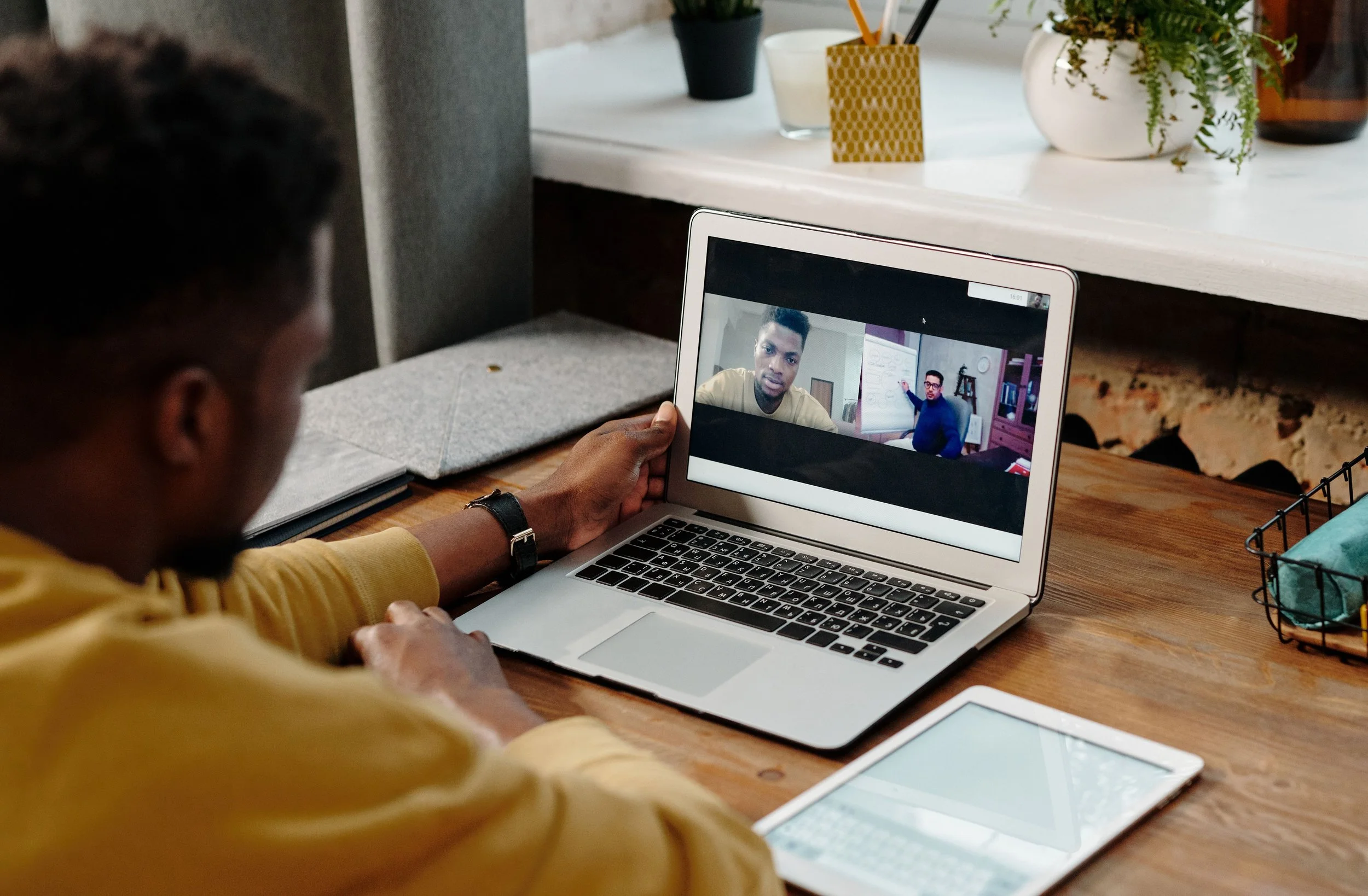
Photo by Diva Plavalaguna via Pexels.
And that brings me back to why I created it in the first place. Nobody handed me a work assignment that said, “Design a cross-site collaboration system.” I just saw a problem and became interested in solving it.
I'm realizing that this is a pattern for me. When I'm given a responsibility, my brain rarely stops at, What am I supposed to do? Eventually, I start asking: Why are we doing it this way? Where is the friction? What keeps happening over and over again? Is there something missing, and could a resource, process, training, system, or tool make this easier?
Once I see the possibility of building something, I can disappear into it for hours. Not literally disappear. I do still require food. But I can become intensely focused when I'm designing, writing, organizing information, solving a problem, or turning a messy idea into something usable.
That realization has helped me understand that creative ownership matters to me more than I realized. For a long time, I thought autonomy was mostly about flexibility, but I'm beginning to understand that, for me, it's also about having enough mental space to think. Creativity requires a certain amount of uninterrupted brainpower, and I'm learning to pay attention to the conditions that either protect that brainpower or constantly chip away at it.
I don't do my best thinking when my attention is constantly being redirected or when too much energy is going toward being visibly busy rather than producing something meaningful. Highly rigid structures, frequent interruptions, and environments where I'm constantly shifting my attention can leave me surprisingly exhausted. The interesting part is that I don't think that means I want to work less. I think I want the conditions that allow me to work deeply.
Give me a real problem, some ownership, and enough room to investigate it, make connections, create something, test it, realize part of it makes absolutely no sense, fix it, and make it better. I will probably have 14 tabs open at some point in this process. But something is getting made.

Photo by Katerina Holmes via Pexels.
That distinction has become important as I think about the next phase of my career. I'm learning that I need work where creativity isn't something I squeeze into the margins after completing the “real” work. Creating, improving, designing, and problem-solving are some of the ways I do my best work. I need meaningful output and the ability to point to something and say, There was a problem here. I thought about it. I built something that might make it better.
That doesn't mean every day needs to be exciting. Some days are spreadsheets, emails, meetings, revisions, and the administrative tasks that come with being employed by another human organization. That's life. But somewhere in the work, I need room to make things.
The Google Classroom initiative helped me see that more clearly. I started with a practical question about how teachers who teach the same content, but work in different places and on different schedules, could actually function more like a professional learning community. Somewhere along the way, that turned into a much more personal question: What conditions allow me to do my best work?
I'm still figuring out the complete answer, but creativity, problem-solving, ownership, autonomy, and the opportunity to produce something meaningful are definitely on the list. I thought this project was mostly about solving a collaboration problem for teachers. It turns out that sometimes a project teaches you as much about yourself as it does about the problem you were trying to solve.